
TABLE OF CONTENTS
- Ways to Add Items to Documents
- How to Set Negative Item Value
- Mapping with Catalog
- How to Update Prices by Catalog
- Saving Items from Documents to the Catalog
- Auto-Updating Catalog Prices from Latest Approved Purchases
Ways to Add Items to Documents
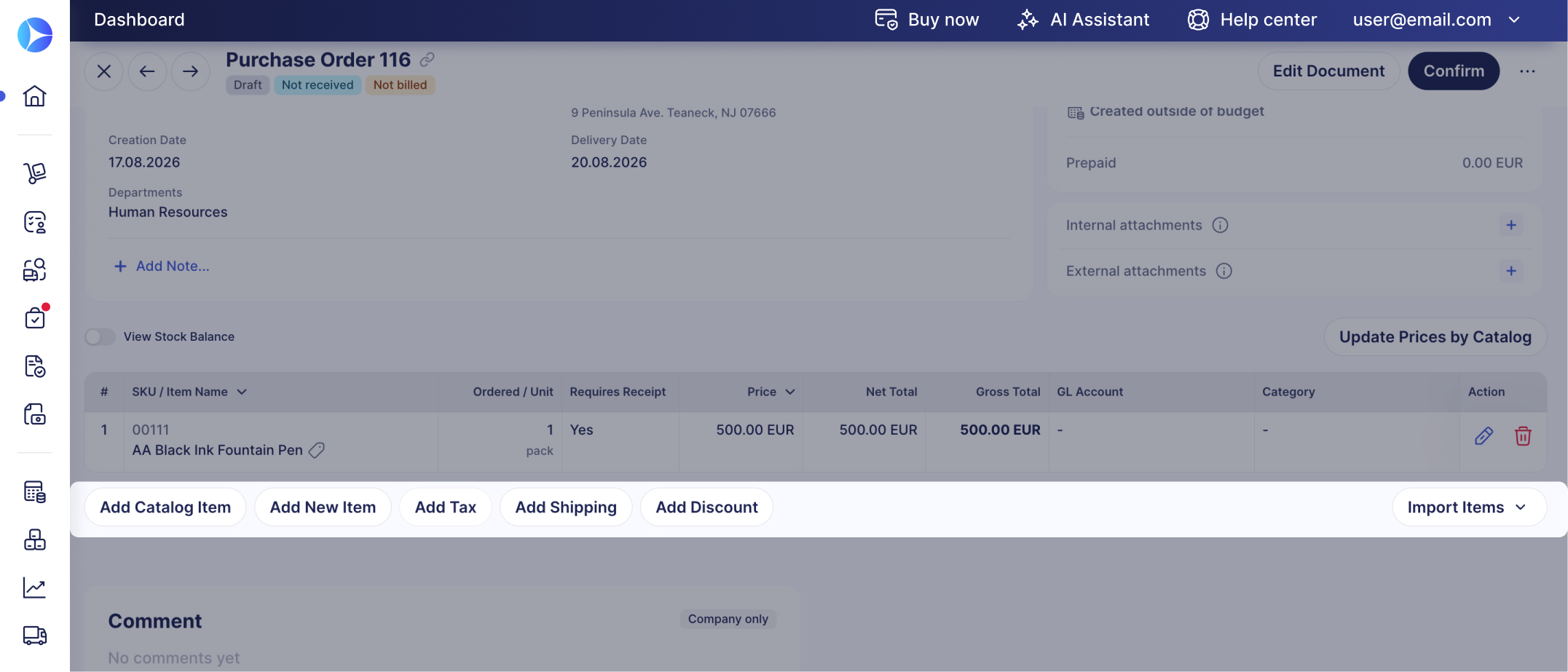
Precoro offers several ways to add items to a document. These options can be found below the document’s main information, Custom Fields for Documents block, and Note.
-
Add Catalog Item—adding previously created items from the Item Management list. When you're selecting items to add to the document, you can click the Check in stock button next to the item name to see how many units of this item are currently in the inventory.
The catalog list in a document is filtered by three conditions at the same time:
- Supplier—if a document-level supplier is selected, the catalog shows only items linked to that supplier and items with no supplier assigned.
- Currency—items must be in the document currency. Free-of-charge items are shown regardless of currency.
- Item type—purchase orders accept all item types. Service orders accept only Non-Inventory and Service items; Inventory items are not available for selection.
If the catalog list is empty, check these three conditions first.
If no existing item matches, you can add a non-catalog item (in purchase orders, purchase requisitions, and invoices) or create the item directly from the document, if Allow Adding Items from Documents to Catalog is enabled in Configuration.

💡 Please note: To use the options listed below in Purchase Orders, Purchase Requisitions, and Invoices, please check the Allow Adding Non-Catalog Items setting for these modules in Configuration → Basic Settings → Document Setup.
- Add New Item—adding items by manually filling out the details such as SKU, name, price, and custom fields.
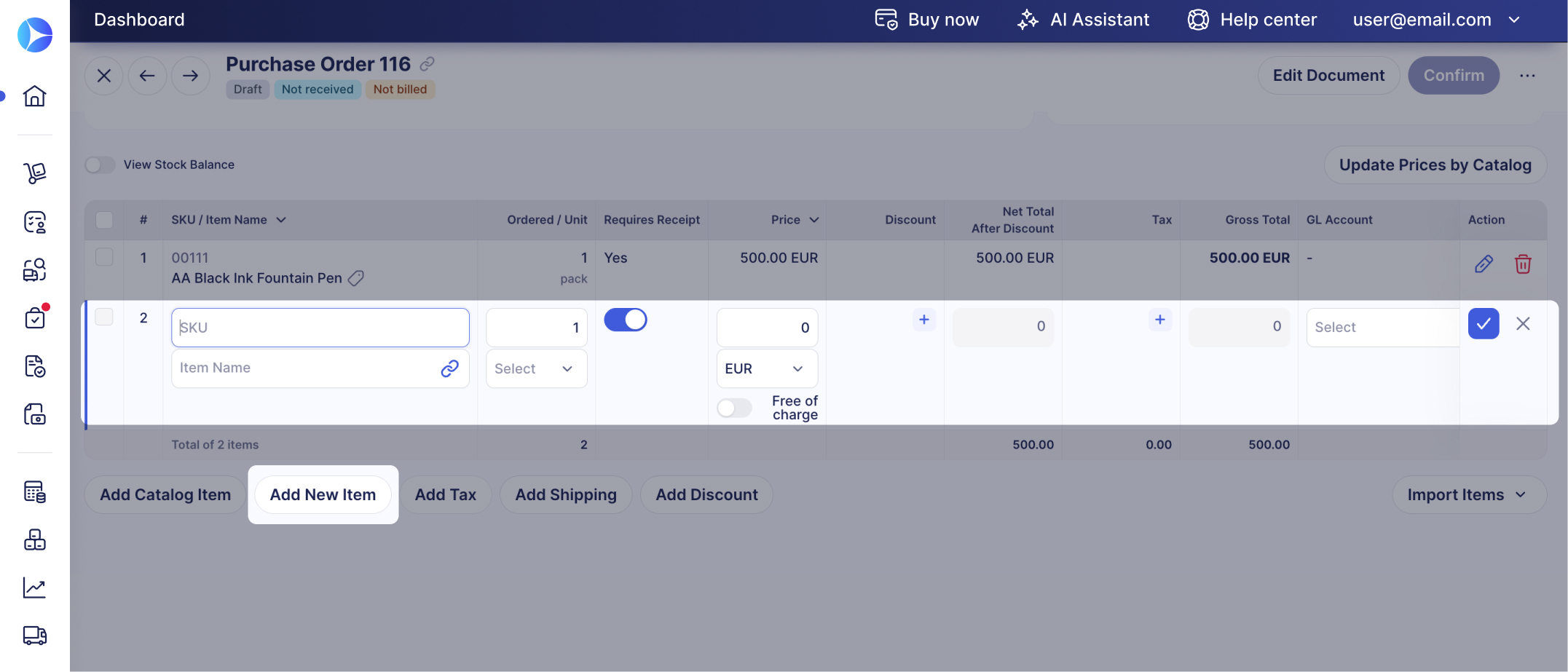
- Add Tax—adding the tax items to your custom and standard POs, invoices, PRs and Service Orders.
- Add Shipping—adding the Shipping to your document.
Please read the following instructions to successfully perform this action with different documents: Shipping Item Type.
-
Add Discount—adding fixed-amount discounts to your document.
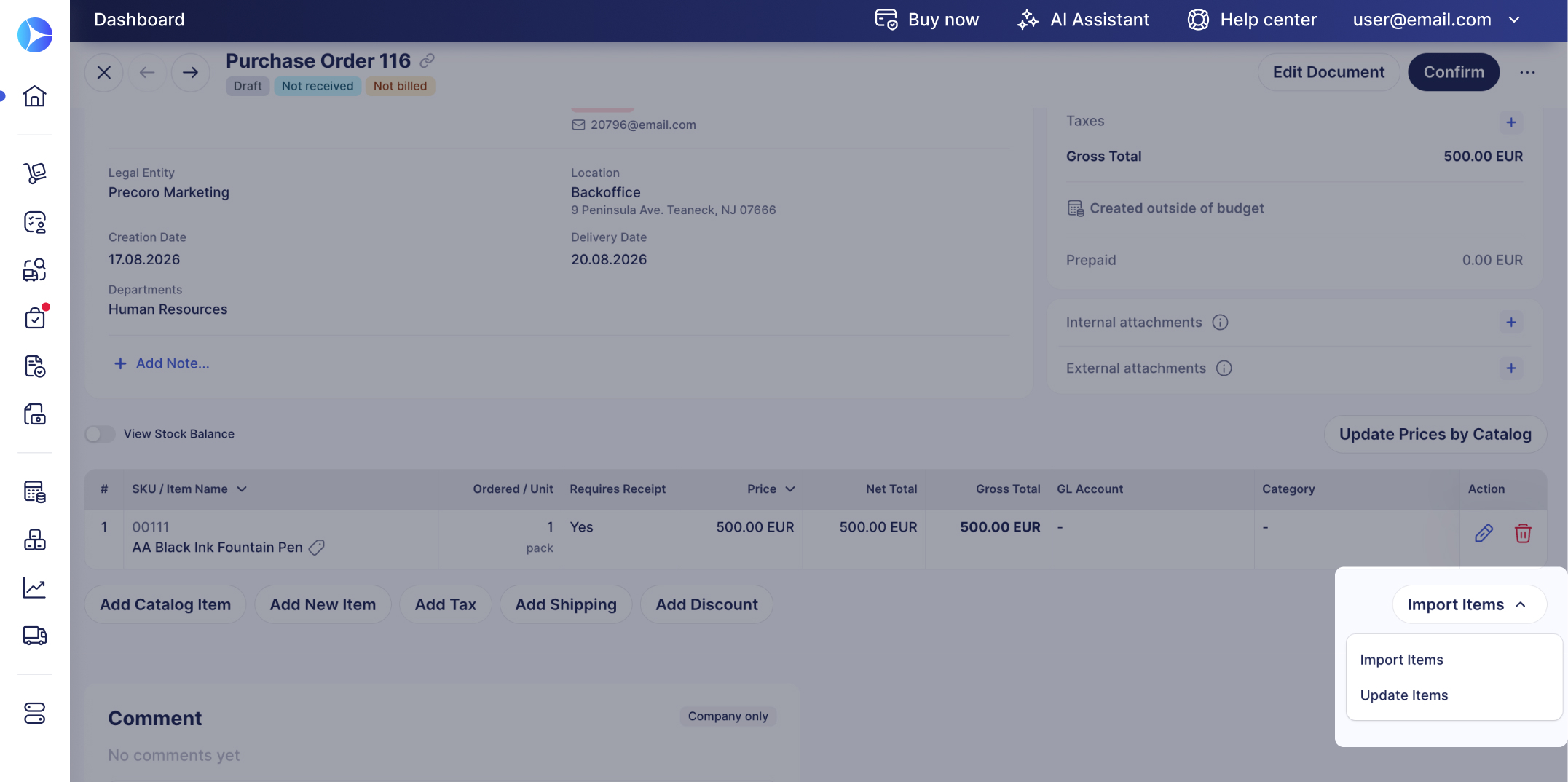
- Import Items—importing Items from an Excel document.
Please read the following instructions to successfully perform this action with different documents: How to Import Items in Bulk.
- Update Items—updating Items from an Excel document.
Please read the following instructions to successfully perform this action with different documents: How to Update Items in Bulk.
How to Set Negative Item Value
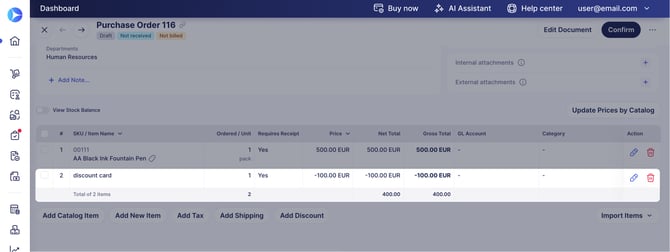
You can enter negative item values in Purchase Orders, Service Orders, Purchase Requisitions, Requests for Proposals, Invoices, and Expenses.
💡 Please note:
- You can Confirm a Purchase Order, Purchase Requisition, Request for Proposal, or Invoice if the document's total is 0 or greater.
- To Confirm a Service Order, ensure the total is greater than 0.
All users with the necessary roles to create documents and add items can use this functionality.
When setting a negative value, please note the following:
- You can add taxes for a negative-value item.
- You can import and update items by entering negative values in the files.
- You can view the negative item values in Reports.
- You can't enter negative values in the Credit Note document.
💡Please note: you can also mark items as Free-of-Charge. Learn about this functionality here.
Mapping with Catalog
Items that weren’t added from the catalog can be automatically mapped with catalog items. Optional custom fields not entered when adding the item will be assigned based on the catalog.
Automatic mapping can happen in these cases:
- An item added manually corresponds to an item that exists in the catalog.
- An imported item corresponds to an item that exists in the catalog.
- A previously added item was edited to make it identical to a catalog item.
- An item added from a PunchOut catalog corresponds to an item that exists in the catalog.
The fields used for mapping depend on your settings and the fields filled out in the catalog.
| Values For Mapping | Conditions That Must Be Met |
| Name + SKU + Supplier + Currency | Used when a Supplier is assigned for the item and you have enabled the SKU. |
| Name + SKU | Used when the item has no assigned Supplier and you have enabled the SKU. |
| Name | Used when the item has no assigned Supplier and you have disabled the SKU. |
| — | If the item is not in the Catalog, you will need to assign all the custom fields manually. |
If the Supplier Part Number or Manufacturer Details checkbox is enabled in Configuration → Basic Settings → Document Setup → Item Management, Precoro looks for a matching catalog item by priority and stops at the first match:
- Priority 1: supplier name and supplier part number (when Supplier Part Number is enabled).
- Priority 2: supplier name, manufacturer name, and manufacturer part number (when Manufacturer Details is enabled).
- Priority 3: the values in the table above.
Matching ignores letter case and extra spaces, and similar items—like different sizes of the same product—are not confused with each other.
- If the item matches, it takes the SKU from the Catalog, and any empty part number or manufacturer fields on the Catalog item are filled in. Existing Catalog values are never overwritten.
- If it doesn’t match, a new Catalog item is created, with the supplier part number as its SKU.
Either way, SKU stays editable on the document, since the supplier’s original identifier is kept in the Supplier Part Number field.
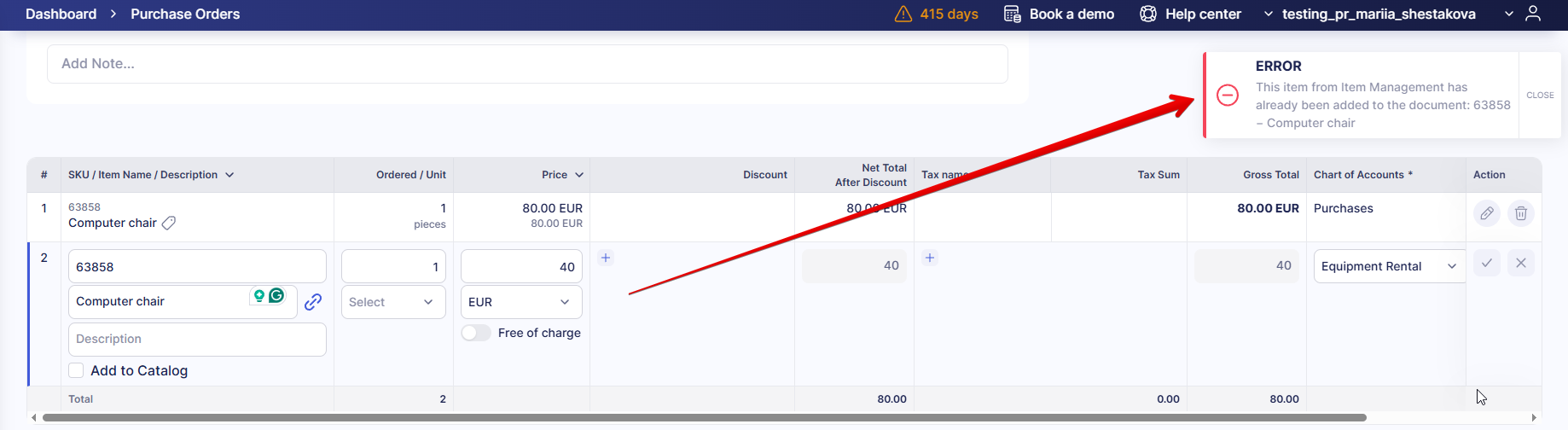
💡 Please note: If an item in a document is automatically mapped with a catalog item that is also added to this document, these items become duplicates.
If the Allow Adding Duplicated Items in Documents setting in Configuration → Basic Settings → Document Setup → Item Management is disabled, you won’t be able to save the changes in the item table. You’ll see the following error: This item from Item Management has already been added to the document (screenshot below).
To resolve this issue, delete a duplicate item.
Saving Items from Documents to the Catalog
This function offers more automation and efficiency when working with items. You can add new entries to the Catalog directly through documents without having to transfer items manually.
💡 Please note: To be able to use this functionality, the user must have an active Item Management Create role.
You can add items directly from the following documents:
- Purchase Order,
- Purchase Requisition,
- Request for Proposal,
- Invoice,
- Expense.
Follow these steps to set up and start using the function:
1. Activate the setting in Configuration → Basic Settings → Document Setup → Item Management → Allow Adding Items from Documents to Catalog.
2. When adding items using the Add button, you will see the Add to Catalog checkbox for each item you create. Check this box to add the item to the Catalog.
3. If you checked the Add to Catalog box, then the item will be automatically saved with the values you have set:
- Price
- Currency
- Custom Fields for Items
- Supplier (this value will be taken from the document).
How to Update Prices by Catalog
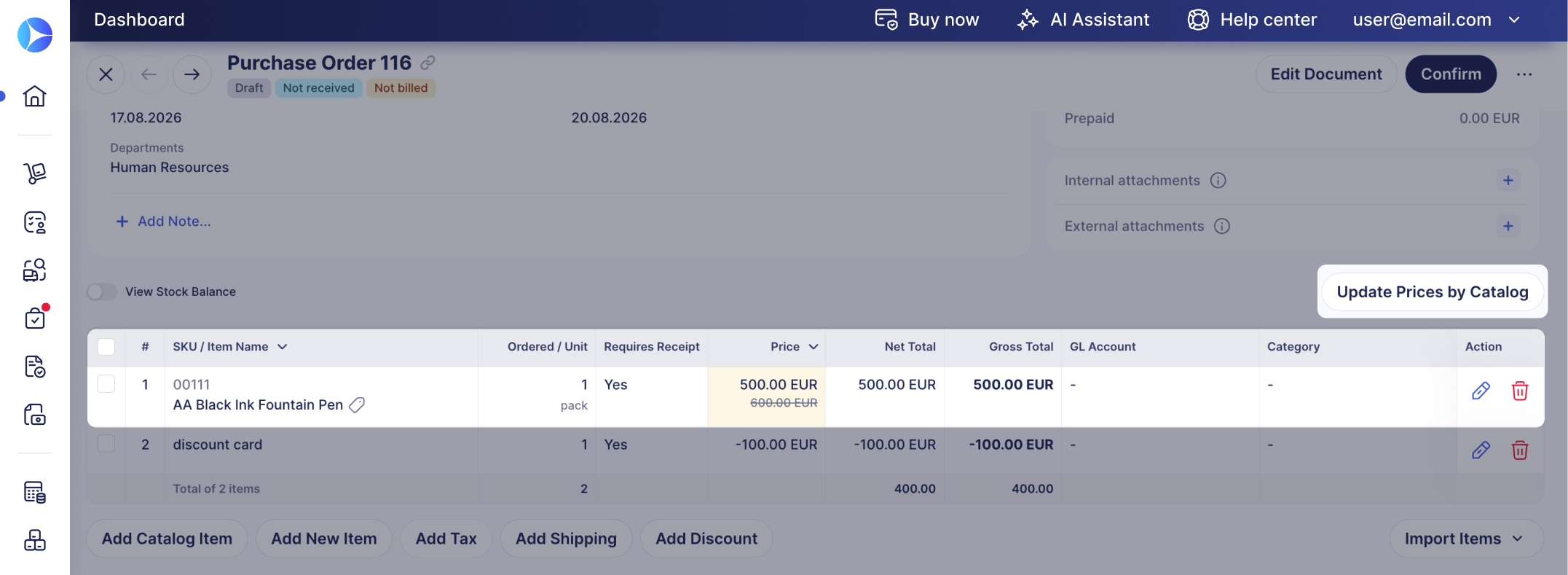
You can update the current item prices in purchase requisitions and purchase orders with just one click on Update Prices by Catalog button.
After a successful update, Precoro will:
- Show a flash message with the number of updated items and the difference in gross total.
- Highlight the updated prices in yellow.
Auto-Updating Catalog Prices from Latest Approved Purchases
To keep your catalog prices accurate and up to date, Precoro also supports automatic price updates based on the most recent approved purchase orders or invoices.
Once a Purchase Order or Invoice reaches the Approved status, Precoro checks if the item price in the document is different from the one in the catalog. If the document doesn’t go through the approval process, the price check happens when it reaches the Completed or Paid status. If the price differs and the auto-update feature is enabled for the item, the catalog price is updated automatically.
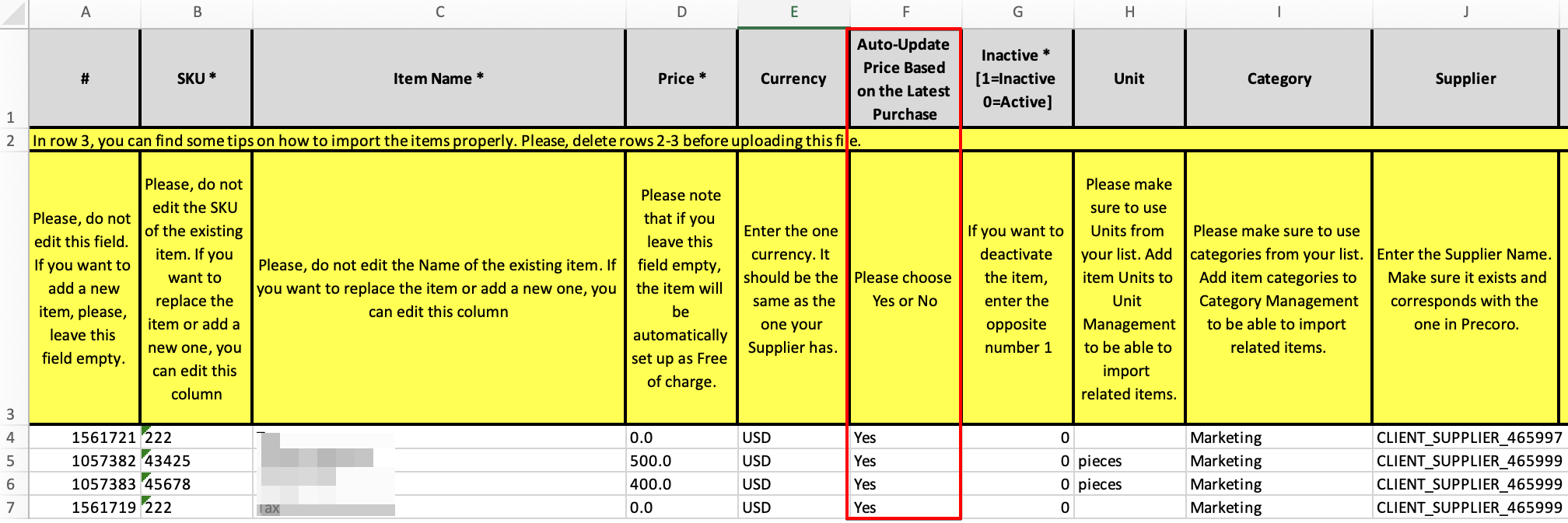
To allow automatic price update for a specific item, go to the Item Management page, edit the item, and check Auto-Update Price Based on the Latest Purchase.

Alternatively, if you want to enable the setting for all or multiple items simultaneously:
- Click the Update Items button on the Item Management page.
- Select the supplier, category, or any needed custom field available in items (optional).
- Click the Download button.
- Open the downloaded file. Set ‘Yes’ in the Auto-Update Price Based on the Latest Purchase column for all the items you want to update.
- Save the file and upload it back to Precoro.
- Click Submit to record the changes.
Precoro updates the item price in the catalog only if all of the following conditions are met:
-
The Auto-Update Price Based on the Latest Purchase setting is enabled for the item.
-
The item comes from the catalog and is added to a Purchase Order or Invoice.
-
The price in the document is different from the current catalog price.
-
The currency in the document matches the one in the catalog.
-
The document has moved to one of the following statuses: Approved, Completed, or Paid.
-
The document was created in Precoro, not imported.
Learn more about this feature in this article.