
TABLE OF CONTENTS
How Does the Integration Work?
The Precoro and Sage Intacct integration simplifies accounting tasks and keeps your financial data synced across both systems. Best of all, you don’t need to be tech-savvy to make it work.
Instead of manually updating invoice information between platforms, the Sage Intacct AP integration handles everything in three easy steps:
-
Request items and approve invoices in Precoro.
-
Once approved, the invoice details flow directly into Sage Intacct.
-
After payment in Sage Intacct, the payment info syncs back to Precoro automatically.
You also get two-way syncing for suppliers and automated transfer of the following lists from Sage Intacct to Precoro:
-
Departments
-
GL accounts
-
Items
-
Locations
-
Projects
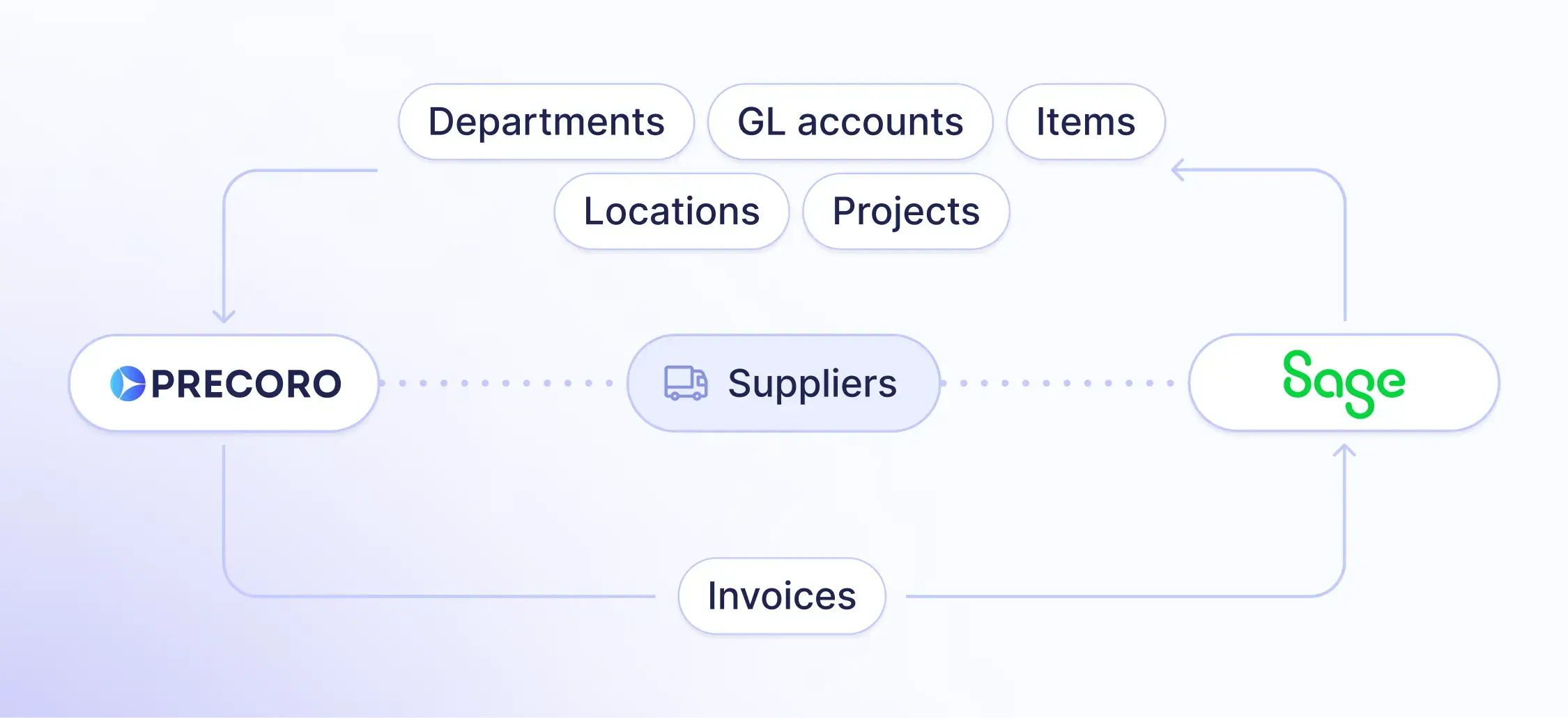
With the Sage Intacct accounts payable automation, you can have peace of mind from manual labor and real-time data in both systems for better control over spend.
Working with Multiple Sage Intacct Entities
If you use Multi-Entity Management, you can connect each Sage Intacct entity to its own legal entity in Precoro. This allows you to:
- Manage multiple Sage entities in one Precoro company with shared settings, catalogs, and workflows.
- Route invoices automatically to the correct Sage entity based on the selected legal entity.
- Split one invoice across multiple locations while keeping it as a single AP bill in Sage.
- Keep suppliers, GL accounts, and dimensions separated by legal entity.
The table shows how data matches between Sage Intacct and Precoro:
| Sage Intacct | Precoro |
| Entities | Legal Entities |
| Locations |
Locations, selected for each item (custom fields for items) |
| Vendors | Suppliers, available for the matching legal entities. |
| GL accounts | GL accounts, selected for each item and available for the matching legal entities. |
| Departments, Projects | Departments, Projects, selected on the document level (custom fields for items) |
| AP bill | Invoices, sent to the Sage Intacct entity that matches the invoice's legal entity |
Departments are available for all legal entities, because Sage Intacct doesn't share which entity a department belongs to.
To set it up, follow the setup steps below. When you contact the Customer Success team in Step 4, mention that you want to connect several Sage Intacct entities.
💡 Please note: If your current integration maps Sage Intacct Locations to Legal Entities in Precoro, it keeps working with that setup. To connect several Sage Intacct entities instead, contact Precoro’s Customer Success team.
Setting Up the Sage Intacct Integration
💡Please note: This integration is a paid add-on, available for purchase if you have the Automation or Enterprise plan. For pricing details, please contact your Customer Success Manager.
Additionally, you must have an active Sage Intacct Web Services developer license, which includes a Web Services sender ID and password. To obtain this license, please contact your Sage Intacct account manager.
A single sender ID can be authorized for multiple companies and tracked via an audit history report.
Once you get the license, please follow these simple steps to configure the integration:
Step 1: Obtain Required Credentials
Start by gathering the following Sage Intacct credentials:
-
Company ID
-
Sender ID
-
Sender Password
-
User ID
-
User Password
To get these credentials, create a Web Services user:
-
Go to Company > Admin > Web Services Users and create a new user.
-
Fill in the fields:
-
User ID
-
Last Name
-
First Name
-
Email: Email of the person managing the integration
-
User Name
-
User Type: Business
-
Admin Privileges: Full
-
-
Then, go to Company > Admin > Roles, find the user you just created, and assign a new role with permissions for the data you want to sync.
-
If not already set up, go to Company > Setup > Company, click "Security," and then "Edit." Under Web Services authorizations, click "Add" and enter the Sender ID exactly as provided by Precoro or Sage Intacct team.
💡Please note: For syncing with Precoro, enable full permissions for Company, General Ledger, Inventory Control, and Accounts Payable.
Step 2: Provide the Integration User
Choose the Precoro user you want the integration to run under, and share their email with the Customer Success team when you contact them in Step 4.
To avoid synchronization issues, choose a user with full system access and no restrictions (by role, group, location, custom fields for documents, etc.).
Step 3: Choose Connection Preferences
Decide on how your integration should work:
-
Invoices: Sync approved invoices from Precoro to Sage Intacct.
-
Suppliers: Maintain two-way syncing of supplier information between both platforms.
-
Payments: Update payment statuses automatically in Precoro from Sage Intacct.
-
Departments, GL Accounts, Items, Locations, Projects: Sync these details from Sage Intacct to Precoro for consistent reporting and management.
- Entities: With Multi-Entity Management, connect several Sage Intacct entities to one Precoro company, with a separate Legal Entity for each. Learn more here.
Step 4: Contact the Customer Success Team
Once you have the setup details ready, reach out to Precoro’s Customer Success team. They will help configure the integration based on your provided preferences.
Frequently Asked Questions